 Sailing with Sea Mercy
Cyclone Recovery in Northern Lau
by Jonathan Robinson, Sea Mercy Coordinator
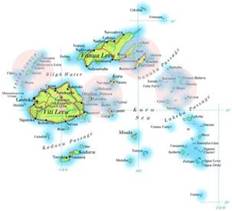
Named the Exploring Isles by a U.S survey
expedition in 1840, the closest of the islands in Fiji’s Lau Group lies over
100nm. to windward of the country’s nearest Port of Entry and a 2 day ferry
trip from the capital, Suva. Until 3 years ago cruising yachts were not
permitted to visit.
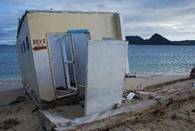
 In the wake of Cyclone Winston’s 320km/h
(200mph) winds, torrential rain, and waves of up to 12m (40ft), Fiji’s National
Disaster Management Office (NDMO) requested Sea Mercy’s assistance with their
recovery. Not only were logistics going to be a challenge to our fleet of small
sailing vessels but the very presence of the yachts was doubtless going to have
a significant cultural impact upon these remote island communities.
In the wake of Cyclone Winston’s 320km/h
(200mph) winds, torrential rain, and waves of up to 12m (40ft), Fiji’s National
Disaster Management Office (NDMO) requested Sea Mercy’s assistance with their
recovery. Not only were logistics going to be a challenge to our fleet of small
sailing vessels but the very presence of the yachts was doubtless going to have
a significant cultural impact upon these remote island communities.
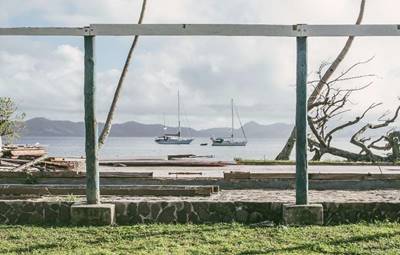
Australian and New Zealand warships first responded
in Koro Island and Northern Lau, identifying the area around Vanua Balavu as one
of the worst hit. By late March they had completed their relief mission and
information reports from the region had dried up.
Many volunteer cruisers, ourselves
included, were spending cyclone season in New Zealand. With the situation in
Lau now unknown we decided to muster vessels in Opua, New Zealand’s
northernmost Port of Entry and take the first acceptable weather window to make
the 1200 nm. passage directly to Northern Lau. A sufferance clearance port
would be established at Lomaloma in Vanua Balavu, with customs, immigration and
biosecurity officials being flown in from Suva on the weekly flight. Fuel drums
and aid would be pre-positioned for us by ferry from Suva.
With the number of volunteer vessels
exceeding sixty, recovery plans were designed, wherever possible, to fit into
and around individual skippers’ sailing preferences. Consequently “rotations”
of vessels were developed allowing crews to participate in different projects
in various locations then releasing them to continue cruising as other vessels
filled their place.
The first eight vessels departed Opua in
mid-May, arriving Fiji via Minerva Reef ten days later. Within 36 hours we had
been cleared in, syphoned the diesel drums dry, distributed the pre-staged aid
supplies and were heading out to conduct Needs Assessment Reports on the most
at risk islands.
During our recovery work in Vanuatu last
year, following the devastation caused by Cyclone Pam, a village Chief had commented:
“This year we had two cyclones. Cyclone Pam and then a cyclone of 1000 people
with clipboards.”
Our Sea Mercy crews don’t carry clipboards.
The New Zealand military had done an
impressive job of immediate response in the major settlements on Vanua Balavu
but the smaller island communities were still in very poor shape. As a primary
school teacher, standing before the ruins of what was once her school, told me
“There is no-one helping our community, only your organization.”
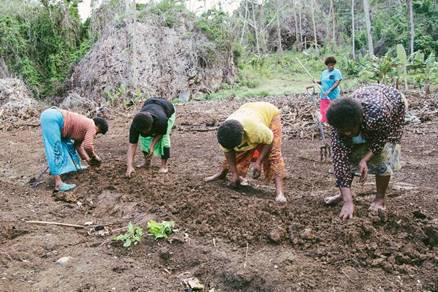
Water, Sanitation and Hygiene (WASH) are
the established priorities following any disaster. The detailed needs
assessment reports by Sea Mercy skippers and crew allowed us to narrow down the
original NDMO target list to 14 communities and 8 schools on the islands of
Vanua Balavu, Avea, Cikobia, Munia and Susui. A total population of around 1200
people.
Rapid prioritization of each community’s
requirements allowed speedy aid requests to be submitted and donated funds were
spent in Fiji to assist with the economic recovery. Subsequent deliveries by infrequent
island ferries would, however, take time.
Chiefs, Headmen and community leaders were away
in Suva, awaiting government rebuilding funds. The main copra plantation was
out of action for at least 2 years and many fishing boats had been damaged or
destroyed. Fishing gear had been swept away and family subsistence gardens flattened.
With their men away, with no income and
with only the occasional fish for protein, the women had attempted to
supplement emergency government rations by replanting their gardens with
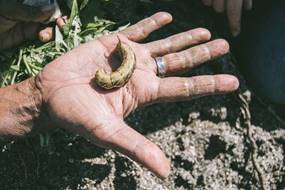
donated seeds. An infestation of caterpillars, previously unknown in these
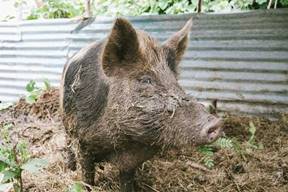
islands, had followed. The few surviving plants were at risk of destruction by
wild pigs.
Morale was low, some communities were leaderless,
many women and children were in tears.
In the outer islands of Avea, Cikobia and
Susui, there was a critical shortage of drinking water. These islands rely on
rain catchment from roofs over the summer to store sufficient water to sustain
them through the dry season. With 80% of this catchment destroyed their
reserves were dangerously low.
Avea Island villagers had hand dug a well
but, being close to shore, it produced only undrinkable, brackish water.
Susui Island has a freshwater spring, which
historically dries in the winter. The spring, now a mere bubble, was
contaminated by coliform bacteria. A Sea Mercy skipper produced long term
plans to reclaim the spring head and clean the water but a short term solution
was urgently needed.
In dire circumstances in the past, the
people of Cikobia Island had relied upon a spring that is accessible only at
low tide. In order to access the water, the villagers needed to dig down
through a meter of sand to the clear water below. The water was then scooped up
into small buckets and carried across the island to the village.
Although Sea Mercy vessels did what they
could, running their own small desalination units and ferrying the precious
water ashore in jugs, they needed a better solution.
A generous donor had made funds available
for Sea Mercy to construct a landing craft with a desalination unit aboard but
the newly launched vessel was over 250 sea miles away and already committed to
other Sea Mercy projects.
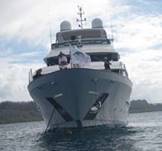 Enter the first of three super yachts to
rally to the cause.
Enter the first of three super yachts to
rally to the cause.
In less than three days they delivered over
15,000 liters of water to the thirsty islands. In their “spare time” they
repaired and repainted Lomaloma hospital’s damaged children’s and labour wards.
Sea Mercy crews installed a solar powered
desalination unit in Avea.
While demand still exceeded supply, water
insecurity fears had been temporarily ameliorated.
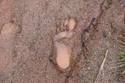 The Irish poet W.B Yeats famously wrote “I
have spread my dreams under your feet.
The Irish poet W.B Yeats famously wrote “I
have spread my dreams under your feet.
Tread softly because you tread on my dreams.”
Every village took a sponsor vessel whose
crews became deeply and often emotionally involved in their community.
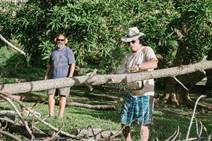 Mindful of village
sensitivities and working under the watchful direction of their sponsors, teams
of cruisers cleared village paths, chain sawing and milling the deadfall to
construct shelters.
Mindful of village
sensitivities and working under the watchful direction of their sponsors, teams
of cruisers cleared village paths, chain sawing and milling the deadfall to
construct shelters.
They erected pig-proof fencing around
gardens, delivered a programme of gardening education, introduced composting
techniques and developed, mixed and delivered an organic pesticide that
successfully removed the caterpillar scourge.
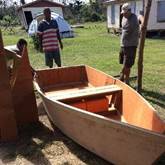 Fiberglass fishing boats
were repaired when possible, and new wooden ones would be built from scratch.
Fiberglass fishing boats
were repaired when possible, and new wooden ones would be built from scratch.
When the first ferry load of aid arrived it
felt like the whole of Vanua Balavu turned out to assist with the offload. Timber,
roofing iron, gutter kits, biosecure seeds, fishing gear, and boat repair and construction
materials were just some of the items that were loaded into local trucks and island
longboats.
It was the first of many long but rewarding
days and nights spent on the wharf at Lomaloma.
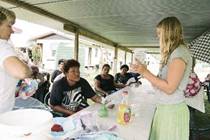 Visiting Fijian
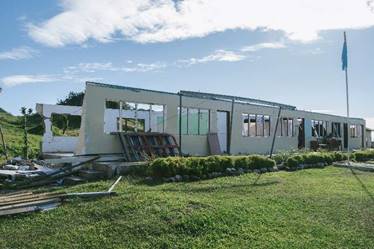
psychiatric counsellors expressed their concern over the impact that the
cyclone had had on the children. Before Winston there had been seven primary
schools and one secondary school in our area of concern. Only two schools had
survived. Children were being taught in abandoned house ruins, and UNICEF tents
that rattled and shook whenever the wind blew, distracting and then scaring the
students.
Visiting Fijian
psychiatric counsellors expressed their concern over the impact that the
cyclone had had on the children. Before Winston there had been seven primary
schools and one secondary school in our area of concern. Only two schools had
survived. Children were being taught in abandoned house ruins, and UNICEF tents
that rattled and shook whenever the wind blew, distracting and then scaring the
students.
 One of our skippers wrote:
“When we first arrived, we visited a school, and a little girl of 5 or 6
spontaneously started to cry loudly when she saw us arrive. We were told by the
headmaster that children sometimes associate “white people” with disasters such
as cyclones. Because that is when the “white people” all arrive: right after
such events! This little girl had been traumatized and, upon seeing us all
arrive, she was reminded of the terrible day of the storm...or perhaps she’d feared
the worse: another cyclone!” s/v Amelie IV.
One of our skippers wrote:
“When we first arrived, we visited a school, and a little girl of 5 or 6
spontaneously started to cry loudly when she saw us arrive. We were told by the
headmaster that children sometimes associate “white people” with disasters such
as cyclones. Because that is when the “white people” all arrive: right after
such events! This little girl had been traumatized and, upon seeing us all
arrive, she was reminded of the terrible day of the storm...or perhaps she’d feared
the worse: another cyclone!” s/v Amelie IV.
The vessels with children onboard sent them
into action. Shared lessons and sports put smiles back on sad faces although
the finer points of rugby remain a mystery to our North American children.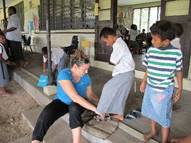
Nearly every school library had been
destroyed. “Boat schooling” educational materials were downloaded onto 64G
memory sticks and given to every head teacher. Additional requests for school
sports and safety equipment were submitted.
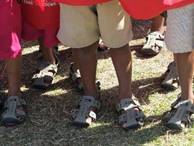
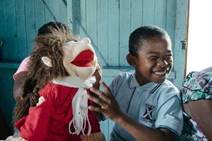 While a cruising family
educated and entertained the children with puppet show performances that
rivalled any Jim Henson production, an American teenager and her mother shipped
300 pairs of “The Shoes That Grow.”
While a cruising family
educated and entertained the children with puppet show performances that
rivalled any Jim Henson production, an American teenager and her mother shipped
300 pairs of “The Shoes That Grow.”
Later, while distributing a pair to every
primary school child, we realized that this was less about the footwear and
more about the compassion shown to these children by a mother and daughter from
the other side of the world.
Our initial fleet had been temporarily reinforced
by vessels of the World ARC rally who, through their “Raise Your Waterline”
initiative, donation items ranging from sauce pans to solar panels.
Additional vessels beat to windward against
the strengthening trade winds, to deliver bags of donated clothing, sorted and
loaded by volunteers.
Upon arrival from New Zealand, still more
volunteer vessels had sailed directly to other Sea Mercy projects: building a
school in Makogai, a water project in Batiki, delivering aid to Taveuni and
servicing Sea Mercy desalination units in the Yasawas.
 The original group of vessels, with whom we
had sailed from New Zealand, rotated out of Lau and for part of July, we alone
were privileged to sail these beautiful cruising grounds.
The original group of vessels, with whom we
had sailed from New Zealand, rotated out of Lau and for part of July, we alone
were privileged to sail these beautiful cruising grounds.
An extract from my report of July 1 reads:
“Susui Island reports only 1 week’s
reserve of water remaining. Rationing remains in place at one bucket per
household per day…Further water deliveries are urgently needed…..The Provincial
Health Officer expressed her concerns to me over sanitation (in other
villages)….long drop drums….are reported nearly full with no replacements.”
I became overly familiar with the
construction of “pour flush privy” water seal toilets. Cement and wire mesh was
ordered and shipped for construction, molds were transported to affected
villages and empty fuel drums, for the surviving traditional “long drops,” sourced
and delivered.
Winston had plunged many communities into
darkness, destroying their few existing solar panels, batteries or generators.
A second superyacht generously donated a
solar power pack to each household on Avea Island through Sea Mercy’s “LIGHT A
VILLAGE” initiative. Many other communities remain less fortunate and, with no
immediate prospect of assistance, further donations for this cause are still
desperately needed.
Deliveries of our requested aid supplies
continued and passing cruisers assisted our limited water making efforts. While
every ferry offload was a social occasion and the interaction with fellow
cruisers a pleasant interlude, the shortage of fresh water remained the major
obstacle to a successful recovery.
A third visiting superyacht donated and
delivered a water filter for every household at risk from contaminated spring
water but Susui Island’s spring was all but dry.
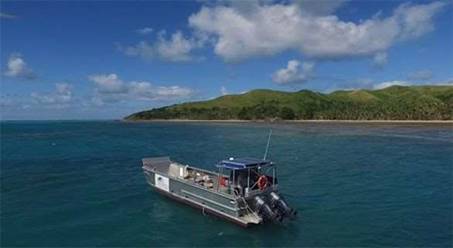
Sea Mercy’s landing craft, with its
sizeable desalination unit had been operating flat out since its recent launch.
A crossing of the Koro Sea in such an uncomfortable vessel, this late in the
season, was definitely not for the faint of heart. The skipper was undeterred.
In early August, despite the weather necessitating
an inventive choice of route into the reef system, the barge finally arrived. Supported
by a returning Sea Mercy vessel, the crew set about the desalination and
delivery of over 100,000 liters of water to the dehydrating islands.
Six months after Winston and the recovery was
under way.
Government building materials were
beginning to be shipped in, complimenting those which Sea Mercy had already provided.
Village vegetable gardens were producing, water catchment systems had been
repaired and fishing boats refloated. Toilets were under construction and the
New Zealand High Commission had invited tenders to repair or rebuild all but
one of the damaged schools. The children in the outer islands now had sports
equipment, sports uniforms and lifejackets for their often hazardous open boat
voyages to Vanua Balavu.
Sea Mercy’s Floating Healthcare Clinic vessel
was on station and everyone now had enough clean water to see them through
until the rains.
It was time to leave.
Three and a half months after sailing from
Opua, my wife and I bid an emotional farewell to the people of Northern Lau.
Around 50 cruising vessels sailed through
the waters around Vanua Balavu during our time there, almost 80% contributed to
Sea Mercy’s recovery effort. Some stayed for 6 weeks, others a few days. Three pulled
“double duty,” departing to return with fresh crew and supplies and several
generously raised their waterline as they passed through. Cruisers in other
ports spent long days sorting warehouse aid before sailing to support e recovery
efforts in other locations.
Within 24 hours of Winston’s impact Sea
Mercy crews were the first on the ground………. they were also the last to leave.
I have not named names, there are too many
people to thank. Every single crew member and volunteer should be proud of
their contribution.
Nobody signed on to Sea Mercy in search of
fame or recognition and much of what they did will remain untold.
Their reward was found in the eyes, hearts,
smiles and songs of the people of Fiji.

 Coastal Boating (Reg. in Ireland No. 443222) is a division of Knowledge Clinic Ltd.